
Benchmarking
Infrared Camera ADC-to-Temperature Conversion Uncertainty Quantification
Sensors such as the FLIR Ax5 family of thermal imaging cameras are an important part of many industrial, manufacturing, and autonomous systems. This use case example quantifies the ease of implementation and the speed of execution, of automating the uncertainty quantification (UQ) of sensor data conversion firmware for the FLIR Ax5. The evaluation runs the software of the use case over an instance of the Signaloid Compute Engine. The output of the execution is both the usual calibrated temperature output as well as programmatically-accessible information on the uncertainty of the calibrated temperature outputs as a function of the measurement uncertainty in the raw sensor transducer voltage output. Such UQ can provide valuable design-time as well as real-time safety information. The implementation overhead and execution cost of the status quo method of Monte Carlo simulation however discourages many organizations from implementing UQ for sensor data conversion routines. FLIR provides public documentation of the mathematical operations they perform on the raw radiometric data to convert them to temperatures and their cameras provide access to the raw radiometric data as well as the necessary complementary calibration parameters. Based on the implied uncertainty given by the number of significant digits in the calibration values provided by FLIR to set the default calibration parameter uncertainty for their Ax5 cameras, combined with propagating that through the equations for converting between radiometric counts and calibrated temperature readings, there is uncertainty in the object temperature.

Figure 1. Monte Carlo UQ implementation
Signaloid's technology makes it possible, for the first time, to take existing transducer output calibration firmware and perform uncertainty quantification on it, with low engineering effort and with low computation overhead. These benefits open the door to pervasive implementation and use of UQ, even permitting real-time uncertainty quantification within edge-of-the-network autonomous systems.

Figure 2. Signaloid UQ implementation
Uncertainty quantification of the ADC-to-temperature conversion routines in the FLIR Ax5 firmware running on the Signaloid Cloud Platform with single-threaded Signaloid C0Pro-M cores runs 613x faster than an already fast C-language Monte-Carlo-based implementation of the same firmware running on an Amazon AWS r7iz high-performance server instance.
Key Performance Indicator
Signaloid Platform Solution
Competing Solution
Signaloid Benefit
Speed for same uncertainty quantification quality.
Run existing non-Monte-Carlo code and use either the Signaloid Compute Engine's automated ingestion of distribution information, or use the Signaloid UxHw API to set program variables as probability distributions.
Run existing Monte Carlo code, or, starting from non-Monte-Carlo code, modify code to implement Monte Carlo sampling, iteration, and aggregation of the results from the Monte Carlo iterations of the computation.
613x faster execution time than 6.8M-iteration Monte Carlo, while achieving same fidelity of full distribution result.
The underlying distribution representations are not literal histograms: The distribution plots use an adaptive algorithm to render a mutually-consistent and human-interpretable depiction for both the Signaloid distribution representations and the Monte Carlo samples, to permit qualitative comparison.
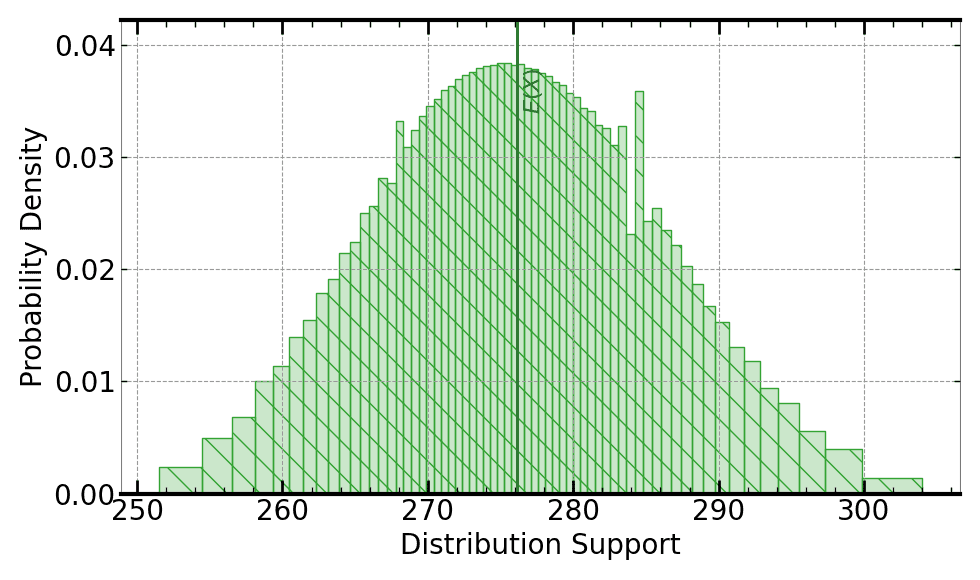
Plot of output distribution when running on a Signaloid C0Pro-M core that provides the 613x speedup.
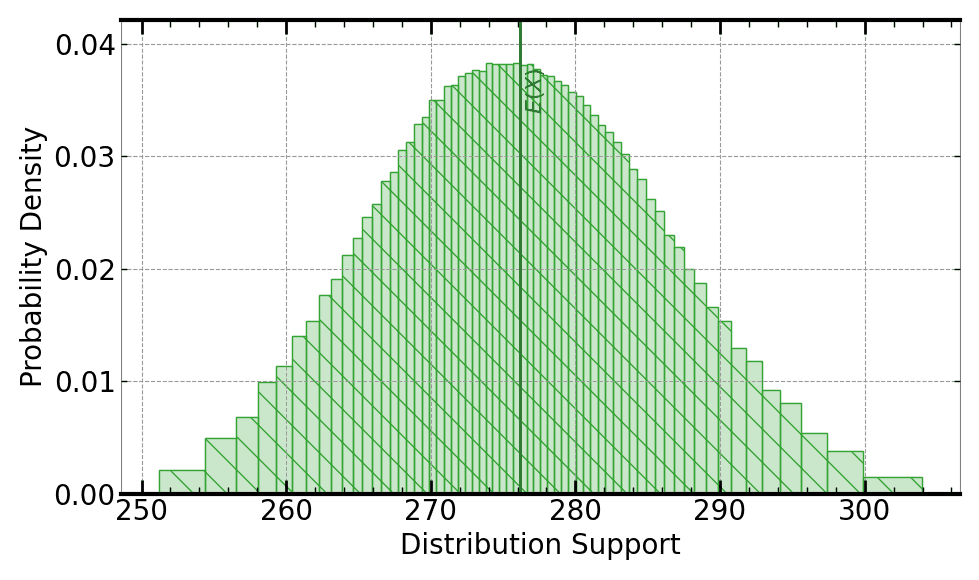
Plot of the output of an 6.8M-iteration Monte Carlo for this use case. This Monte Carlo iteration count provides the same or better Wasserstein distance to ground truth (20M-iteration) Monte Carlo as execution on a Signaloid C0Pro-M core (which is 613x faster).
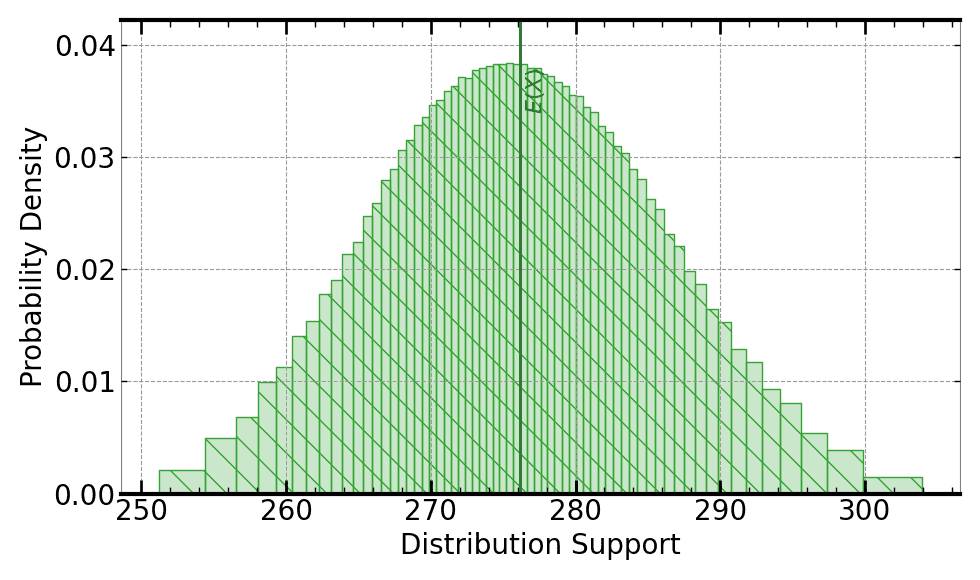
Plot of ground truth (20M-iteration) Monte Carlo.
Benchmarking Methodology
Monte Carlo simulations work by statistical sampling and therefore each multi-iteration Monte Carlo run will result in a slightly different output distribution. By contrast, Signaloid's platform is deterministic and each run produces the same distribution for a given Signaloid C0 core type.
The performance improvements are calculated by comparing Signaloid's platform with a Monte Carlo simulation of a similar quality of distribution. First, we run a large Monte Carlo simulation (about 50M iterations) on an AWS r7iz high-performance AWS instance: We use this distribution result as a baseline or ground truth reference of distribution quality. Then we calculate the performance of Signaloid's technology, and compare it with the performance of a Monte Carlo iteration count where the output distribution's Wasserstein distance (to the output distribution of the ground truth reference) is as accurate as the Signaloid-core-executed algorithm's output distribution, with 95% confidence level.
Performance data based on Fall 2025 release of Signaloid's technology.