
Benchmarking
Financial Securities, Portfolio, and Risk Modeling
The size of an investment portfolio is an important parameter to optimize in order to maximize returns. This example implements a venture capital portfolio model, to calculate the distribution of investment returns for a portfolio of 150 investments.

Figure 1. Monte Carlo UQ implementation
The original formulation of the model uses Monte Carlo simulations to calculate the distribution of investment returns, assuming that the portfolio’s individual investment returns each follow a Pareto distribution (i.e., a power-law distribution). When running on the Signaloid Cloud Compute Engine (SCCE), the kernels implementing the calculation can replace the usual approach of sampling followed by application of the kernel to the sample inputs, replacing it with a direct computation on a representation of the probability distribution of the portfolio model’s parameters. Thus, in a single computation, the code kernel running on SCCE can compute the same type of output distribution that would take a Monte Carlo simulation millions of iterations.

Figure 2. Signaloid UQ implementation
The investment portfolio kernel running on the Signaloid Cloud Compute Engine with a single-threaded Signaloid C0Pro-XL core achieves runtimes 125x faster than an optimized C-language Monte-Carlo-based implementation of the same kernel running on an Amazon EC2 R7iz instance. With 95% confidence, a 17M-iteration Monte Carlo implementation will have the same accuracy as the Signaloid UxHw®-based version, yet the Signaloid UxHw-based version gives the speedup quoted above; if requiring higher confidence in the accuracy of the Monte Carlo compared to UxHw, the speedups of UxHw are even greater.
Key Performance Indicator
Signaloid Platform Solution
Competing Solution
Signaloid Benefit
Speed for same uncertainty quantification quality.
Run existing non-Monte-Carlo code and use either the Signaloid Compute Engine's automated ingestion of distribution information, or use the Signaloid UxHw API to set program variables as probability distributions.
Run existing Monte Carlo code, or, starting from non-Monte-Carlo code, modify code to implement Monte Carlo sampling, iteration, and aggregation of the results from the Monte Carlo iterations of the computation.
125.8x faster execution time than 17.7M-iteration Monte Carlo implemented in C for the same portfolio size of five, while achieving same fidelity of full distribution result.
The underlying distribution representations are not literal histograms: The distribution plots use an adaptive algorithm to render a mutually-consistent and human-interpretable depiction for both the Signaloid distribution representations and the Monte Carlo samples, to permit qualitative comparison.

Plot of output distribution when running on Signaloid C0Pro-XL that provides the 125x speedup.
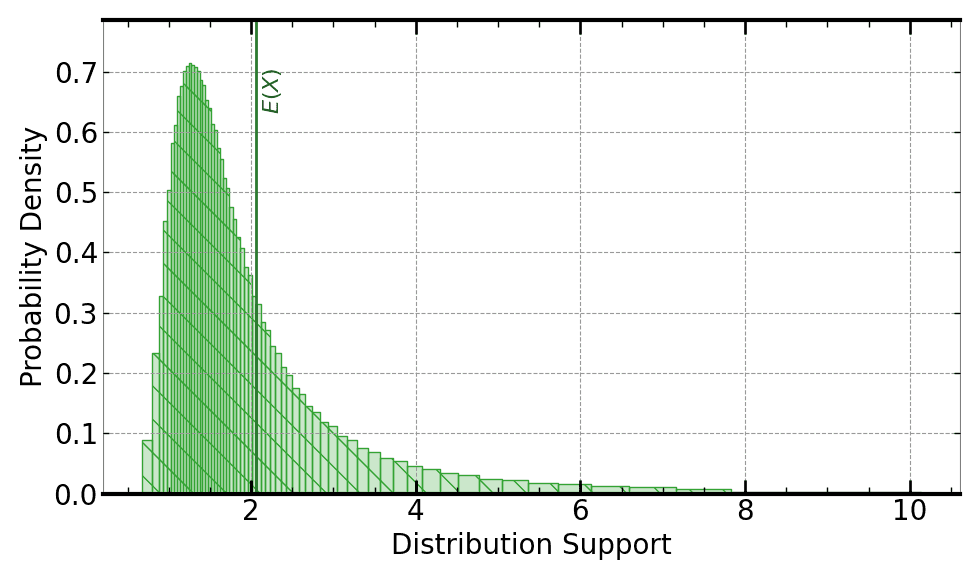
Plot of the output of an 17.7M-iteration Monte Carlo for this use case. This Monte Carlo iteration count provides the same or better Wasserstein distance to ground truth (20M-iteration) Monte Carlo as execution on a Signaloid C0Pro-XL core (which is 125.8x faster).

Plot of ground truth (20M-iteration) Monte Carlo.
Benchmarking Methodology
Monte Carlo simulations work by statistical sampling and therefore each multi-iteration Monte Carlo run will result in a slightly different output distribution. By contrast, Signaloid's platform is deterministic and each run produces the same distribution for a given Signaloid C0 core type.
The performance improvements are calculated by comparing Signaloid's platform with a Monte Carlo simulation of a similar quality of distribution. First, we run a large Monte Carlo simulation (about 50M iterations) on an AWS r7iz high-performance AWS instance: We use this distribution result as a baseline or ground truth reference of distribution quality. Then we calculate the performance of Signaloid's technology, and compare it with the performance of a Monte Carlo iteration count where the output distribution's Wasserstein distance (to the output distribution of the ground truth reference) is as accurate as the Signaloid-core-executed algorithm's output distribution, with 95% confidence level.
Performance data based on Fall 2025 release of Signaloid's technology.